Air starter vs electric starter: which suits your diesel engine?
An air starter cranks a diesel engine using stored compressed air, while an electric starter uses current drawn from a battery bank. The practical difference is where the starting energy comes from: an air starter holds its energy as pressure in a receiver, which does not self discharge, does not weaken in cold, and needs no mains supply to stay charged.
That is why air starting is specified on offshore platforms, ships, mine sites, standby generator sets and fire pump engines, where an engine may sit unused for months and still has to start first time. This is a comparison worth making properly, because the two are not simply interchangeable. An electric starter is cheaper to buy, simpler to install and perfectly adequate on an engine that runs every day with a maintained battery. An air starter earns its place where the consequences of a failed start are serious, where the duty is heavy, or where an electrical spark is unacceptable.
Powerstart manufactures non-electric engine starters in the UK. If you want the mechanism explained rather than compared, see how an air starter works. This article is about choosing between the two.
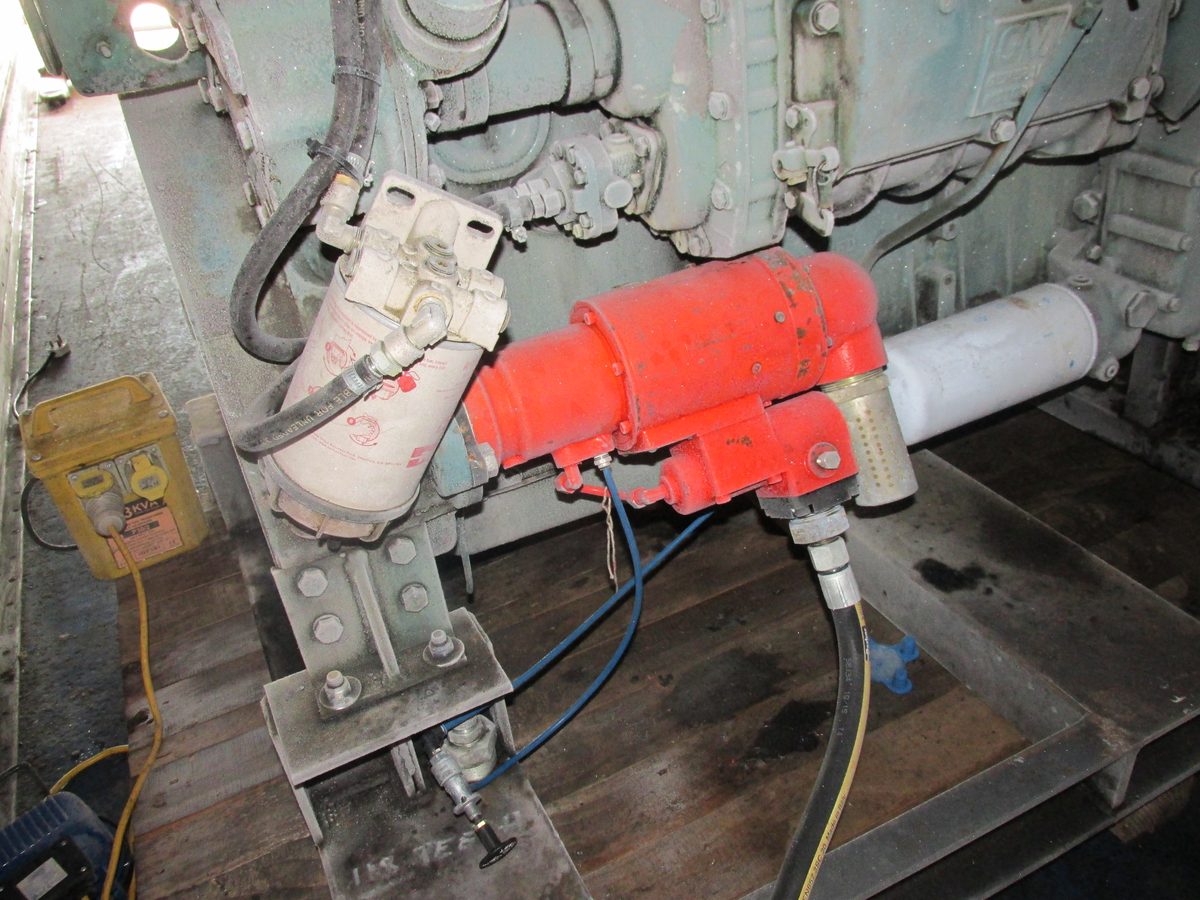
An air starter mounted in place of an electric starter on an industrial diesel engine.
The short answer
Choose an electric starter when the engine runs regularly, the battery is maintained and monitored, the area is not hazardous, and a failed start is an inconvenience rather than an incident.
Choose an air starter when the engine is large, sits on standby for long periods, works in extreme cold or heat, sits in a classified hazardous area, needs repeated cranking attempts with no recovery time, or when compressed air is already available on site.
Side by side
| Air starter | Electric starter | |
|---|---|---|
| Energy source | Compressed air held in a receiver or cylinder bank | Battery bank, kept charged |
| Energy loss on standby | None while the receiver holds pressure | Batteries self discharge and lose capacity over time |
| Cold performance | Unaffected. Air pressure does not fall with temperature the way battery capacity does | Cranking capacity falls sharply as temperature drops, exactly when the engine is hardest to turn |
| Repeat starts | Immediate, back to back, limited only by the air stored in the receiver | Limited. Windings heat quickly and need a cooling interval between attempts |
| Power to weight | High. A turbine air starter delivers high cranking torque for its size | Lower. A large electric starter for a big diesel is heavy |
| Hazardous areas | Pre-engaged models certified to EN1834-1 and EN1834-2, with IECEx options | Requires explosion protected design and certification of the electrical circuit |
| Engine size | Powerstart Jetstream 4 up to 15 litres, Jetstream 5 up to 80 litres | Practical up to mid range engines, then size and current draw become limiting |
| Lubrication | Powerstart air starters run without lubrication | Not applicable, but brushes and solenoids are wear items |
| Infrastructure needed | Compressor, receiver, filtration and pipework, or an existing plant air supply | Battery bank, charger, cabling, isolation |
| Purchase cost | Higher for the starter and the air system | Lower |
Where the electric starter actually fails
In the enquiries we take, a failed start on a standby engine turns out to be a flat or degraded battery far more often than a failed starter motor.
Most starting problems on standby and remote plant are not starter motor problems. They are energy storage problems. A battery that has sat for six months in an unheated enclosure has lost capacity, and it loses more of it the colder the morning is. The starter itself may be in perfect condition and still be unable to turn the engine, because there is nothing left to turn it with.
Three failure patterns come up repeatedly:
- Standby discharge. Lead acid batteries self discharge whether the engine runs or not. Without a maintained charger, the reserve you assumed is there has quietly gone.
- Cold cranking collapse. Battery output falls as temperature falls, while diesel oil thickens and the engine gets harder to turn. The two curves move against each other.
- Thermal limit on repeat attempts. If the first crank does not fire, an electric starter needs a rest. On a fire pump or an emergency generator, that pause is the problem.
An air starting system does not share those failure modes. A receiver at pressure on Monday is at pressure in six months, provided the system is sound. That is the whole argument for non-electric starting, and it is why the specification usually comes down to consequence rather than cost.
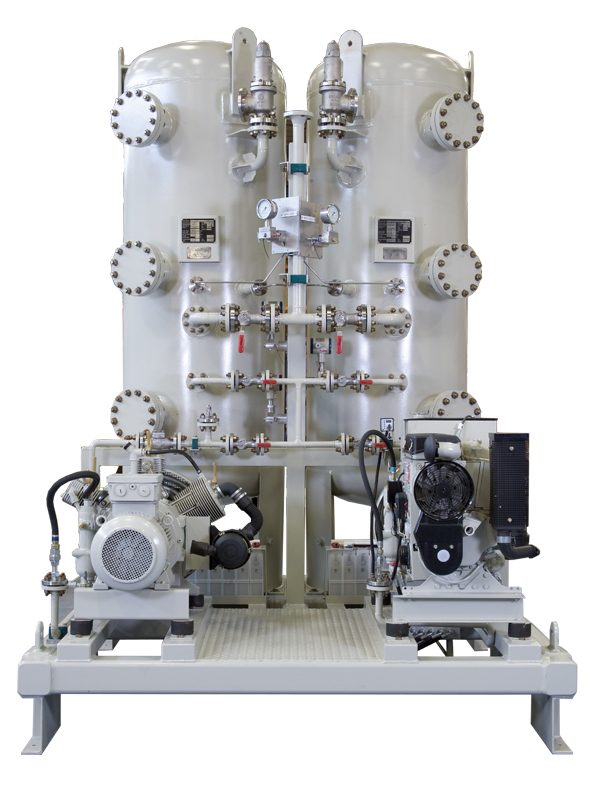
A twin vessel air start package. The stored energy sits in the receivers and does not self discharge.
Cranking torque and why air wins on big engines
An electric starter's torque is limited by the current the battery bank can deliver and the cable can carry. Scaling it up for a large diesel means heavier batteries, heavier cable and a heavier starter, all of which have to be housed somewhere.
An air turbine starter takes a different route. Compressed air is directed through inlet nozzles onto a turbine wheel, which spins at high speed and is geared down to produce cranking torque at the pinion. The result is high torque from a compact, comparatively light unit. On the Powerstart Jetstream 5, for example, the 14 nozzle variant produces a breakaway torque of 338 / 160 / 120 Nm across its inlet pressure options of 8.0 / 6.0 / 3.0 bar.
Powerstart air starters operate anywhere from 3 to 30 bar, specified at order to suit the air supply already on site. If you need to work out whether your compressor and receiver will support the starter, our guide to sizing an air starting system works through receiver volume and consumption per crank.
Hazardous areas: the one place this is not a preference
In a classified zone, an electric starting circuit is a potential ignition source and has to be certified accordingly. A non-electric starter removes the electrical circuit from the starting system entirely.
The feature that matters on an air starter in a hazardous area is the pre-engaged design. A pre-engaged starter meshes the pinion with the flywheel ring gear before the motor turns, which removes the impact and friction of an inertia engagement. It is the pre-engaged models that carry ATEX approval to EN1834-1 and EN1834-2. On the Jetstream 5 a beryllium copper non-spark pinion is available as a further option where the risk assessment calls for it.
For the difference between the certification schemes and which applies to your site, see ATEX vs IECEx engine starters. For the engagement difference itself, see inertia vs pre-engaged starter motors.
What about hydraulic and spring starting?
Air is not the only non-electric option, and on some duties it is not the right one.
- Hydraulic starting stores energy as pressure in a bladder accumulator, nitrogen over oil, in systems typically running around 200 to 210 bar. It needs no compressor and no air receiver, and an emergency hand pump lets an operator recharge the system and start the engine with no power of any kind available. Powerstart's M-Series covers roughly 30 to 216 Nm. See hydraulic starter motors.
- Spring starting stores energy in a wound coiled spring, energised with a detachable crank handle or a cordless drill. It suits diesels of roughly 0.5 to 14 litres and needs no stored fluid or gas at all. See spring starter motors.
Air suits large engines and sites with an existing compressed air supply. Hydraulic suits installations where there is no air and space is tight. Spring suits smaller engines and the simplest possible standby arrangement.
A worked comparison
Take a 12 litre standby generator engine in an unheated plant room in northern Europe, run under load once a month, required to start on demand.
| Consideration | Electric | Air |
|---|---|---|
| Reserve after four weeks idle | Depends entirely on the charger working | Receiver pressure unchanged if the system is sound |
| First crank at minus 5°C | Reduced battery capacity against a stiffer engine | Unaffected by ambient temperature |
| Three consecutive attempts | Needs a cooling interval between attempts | Back to back, if the receiver is sized for it |
| Suitable starter | Battery bank plus charger plus monitoring | Jetstream 4, which covers engines up to 15 litres |
| What can quietly go wrong | A failed charger nobody notices until the day it is needed | A slow leak, which a pressure gauge on the receiver makes visible |
The point of the table is not that air always wins. It is that the two systems fail in different ways, and air starting fails in ways that are visible on a gauge during a routine walk round.
Whole life cost, honestly
An air starting system costs more to buy and install than an electric one. There is a starter, a receiver, a compressor or a tap into plant air, filtration and pipework. That is a real difference and it should be stated plainly.
What changes the arithmetic is what happens afterwards. Batteries are a recurring replacement. Chargers fail. An air starter running without lubrication in a cast iron casing is a long life item, and the stored energy does not need periodic replacement. On a critical engine, the cost that matters is usually the cost of the start that did not happen, not the cost of the starter.
A note on fire pumps. Diesel driven fire pump engines are served by air and hydraulic starting. Spring starters are not suitable for fire pump duty. See NFPA 20 fire pump starting systems for the requirements that apply.
How to decide
- How serious is a failed start? If the answer is an incident, an outage or a safety consequence, non-electric starting is worth the capital.
- How long does the engine sit? Weeks or months of standby argues strongly against relying on a battery.
- What is the ambient? Cold, heat, salt, dust and vibration all degrade an electrical starting system faster than an air one.
- Is the area classified? If yes, look at pre-engaged air or hydraulic starters with ATEX or IECEx certification.
- Is compressed air already on site? If yes, much of the cost argument against air starting disappears.
- How big is the engine? Above roughly 15 litres you are into Jetstream 5 territory, and electric starting becomes progressively less practical.
If you would rather work through it with the engine details in front of you, our engine starting solution finder narrows it down, or send us the specification and we will do it.
Frequently asked questions
What is the main advantage of an air starter over an electric starter?
The main advantage is that the starting energy is held as compressed air, which does not self discharge and is not weakened by cold. An air starter will also crank repeatedly with no cooling interval between attempts, and it delivers high cranking torque for its size and weight. On a standby or emergency engine that has to start first time after months idle, those are the properties that matter.
Is an air starter more reliable than an electric starter?
An air starting system removes the failure modes that cause most standby starting problems, which are battery self discharge, reduced cold cranking capacity and charger failure. It introduces its own requirement, which is a sound air supply held at pressure. That is easier to verify, because a gauge on the receiver shows the stored energy directly.
Can an air starter replace an electric starter on an existing engine?
Often yes, provided there is a compatible mounting flange on the engine, physical space for the unit, and an air supply at the right pressure. To confirm a replacement we need the engine make and model, the capacity in litres, the working air pressure available, the existing mounting flange, and whether the current unit is inertia or pre-engaged.
What air pressure does an air starter need?
Powerstart air starters are supplied for low, medium or high inlet pressure across a 3 to 30 bar range, specified at the time of order. The right option depends on the air supply already available on site, which is why we ask for it before recommending a model.
Are air starters suitable for hazardous areas and electric starters not?
Both can be used in classified areas with the right certification, but a non-electric starter removes the electrical circuit from the starting system altogether. On Powerstart air starters the feature that carries ATEX approval to EN1834-1 and EN1834-2 is the pre-engaged design, because the pinion meshes with the flywheel before the motor turns.
Do air starters need lubrication?
No. Powerstart air starters run without lubrication and are designed as a fit and forget installation, which removes an inline lubricator and its maintenance from the air system.
What size engine can an air starter crank?
The Powerstart Jetstream 4 starts diesel engines up to 15 litres and the Jetstream 5 up to 80 litres. Both are available as inertia or pre-engaged, in cast iron, with ATEX and IECEx options.
Not sure which starting method your engine needs?
Tell us the engine make, capacity, duty and the utilities available on site, and we will confirm the right option. Request a quote or call +44 (0) 121 818 5080.