
Hydraulic starter motors
Engineered power for high-torque, heavy-duty applications, for engines up to 80 litres.
Powerstart’s hydraulic engine starting solutions provide guaranteed reliability for diesel and gas engines up to 80 litres.
This truly independent starting solution is capable of offering black-start (or dead-ship) capabilities. As a result, it can be used as your primary or secondary method of starting an engine. It’s also the ideal choice for emergency generators and those in hazardous areas with ATEX safety requirements.
Powerstart were the first company in the world to manufacture cast iron hydraulic starter motors, making them more robust and longer lasting than those made with alternative materials. Cast iron is especially suited for underground applications, where lighter metals such as aluminum are usually banned.
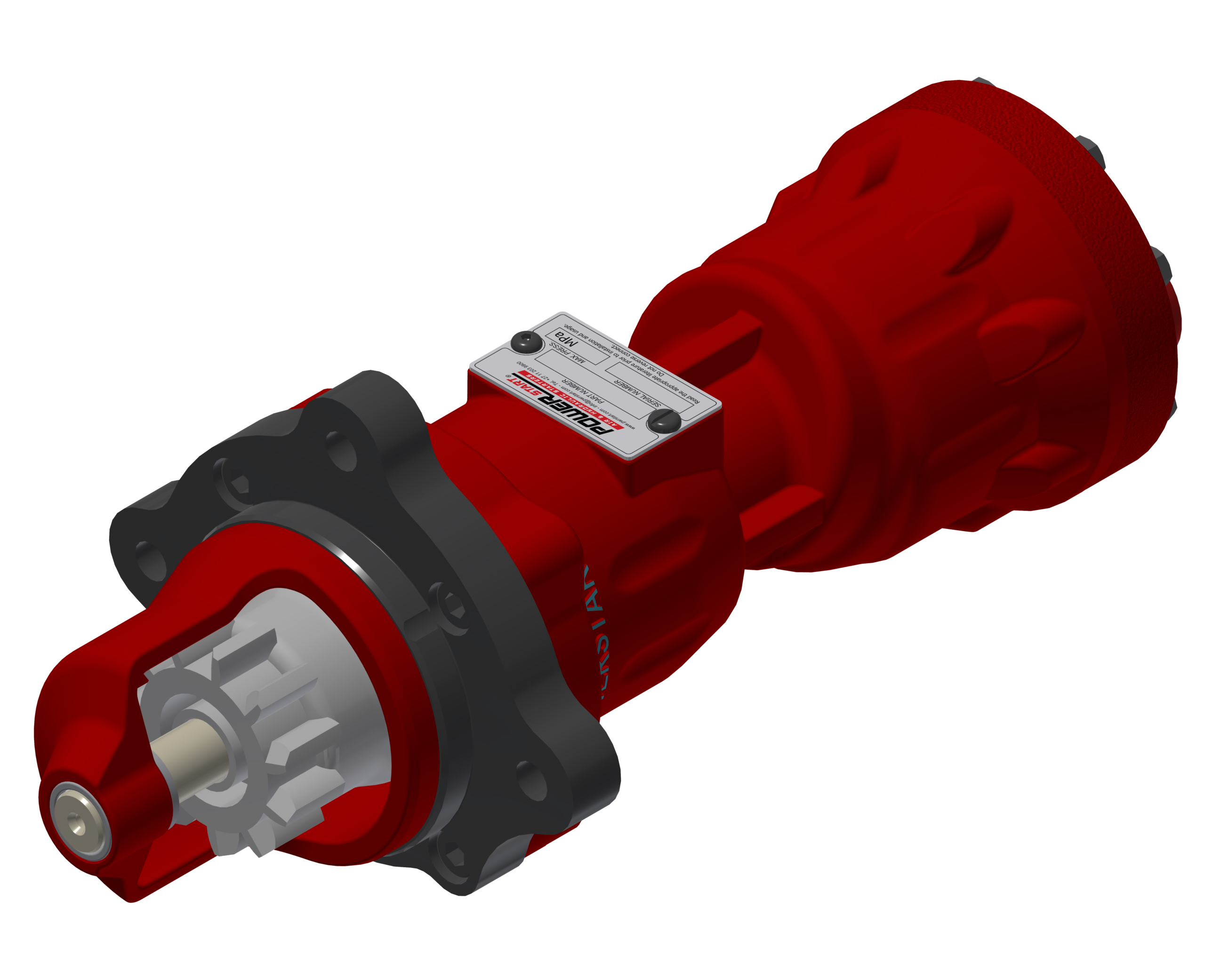
Hydraulic starter models
Model
Max Engine Size
Max Torque

M10
1-4 litres
30 Nm
M16
1-5 litres
48 Nm

M22
3-8 litres
66 Nm
M28
4-12 litres
84 Nm
M33
TBC
100 Nm

M38
TBC
124 Nm
M66
TBC
216 Nm
Hydraulic starter specifications
| Model | Engine capacity | Max torque | Displacement | Speed range | Weight |
|---|---|---|---|---|---|
| M10 | Up to 4 litres | 30 Nm (22 lb·ft) | 9.98 cc | 0 to 4,000 rpm | 9.5 kg (20.9 lb) |
| M16 | Up to 5 litres | 48 Nm (35 lb·ft) | 15.59 cc | 0 to 4,000 rpm | 9.5 kg (20.9 lb) |
| M22 | 3 to 8 litres | 66 Nm (49 lb·ft) | 22.1 cc | 0 to 4,000 rpm | 11.0 kg (24.3 lb) |
| M28 | Up to 12 litres | 84 Nm (62 lb·ft) | 28 cc | 0 to 4,000 rpm | 11.0 kg (24.3 lb) |
| M33 | Ask us | 100 Nm (74 lb·ft) | 33 cc | 0 to 4,000 rpm | 11.0 kg (24.3 lb) |
| M38 | Ask us | 124 Nm (92 lb·ft) | 38 cc | 0 to 3,000 rpm | 21.5 kg (47.4 lb) |
| M66 | Ask us | 216 Nm (160 lb·ft) | 66 cc | 0 to 3,000 rpm | 21.5 kg (47.4 lb) |
All models: 21 MPa (3,000 psi) maximum working pressure, ductile cast iron construction, mineral oil, clockwise rotation as standard with counter-clockwise optional. Steel or beryllium copper non-spark pinions are available. Full specifications and power curves are on each model page.
Hydraulic starters for hazardous areas
For zoned areas, the feature that matters is the pre-engaged design. The M22 and M28 mesh the pinion fully with the ring gear before the motor turns, which avoids the sparks an inertia engagement can cause against a stationary ring gear. These are the two ATEX-approved models in the range.
Across the range, the starting circuit has no electrics, the cast iron casing removes the risk of thermite reactions that lighter alloys carry, and a beryllium copper pinion can be fitted where the risk assessment calls for it. For how the two certification schemes differ, see ATEX vs IECEx engine starters.
Advantages

Powerstart hydraulic starters require no electricity and are completely non-sparking, making them ideal for use in flameproof and hazardous environments.

They deliver higher power-to-weight performance than electric systems, providing more torque per kilogram while reducing overall engine starter weight.

Fully sealed construction ensures immunity to contaminants such as coal dust, corrosive salt spray and other harsh environmental conditions. All moving parts are oil-immersed for long service life.
Frequently asked questions
Which Powerstart hydraulic starters are ATEX approved?
The M22 and M28. Both are pre-engaged, so the pinion meshes with the ring gear before the motor turns. The M22 suits diesel engines of 3 to 8 litres and the M28 engines up to 12 litres.
What size engine will a hydraulic starter crank?
The range covers diesel and gas engines up to 80 litres, from the M10 for engines up to 4 litres to the M66 at 216 Nm. The table above gives each model's torque and capacity.
What pressure do Powerstart hydraulic starters run at?
Every model has a maximum working pressure of 21 MPa (3,000 psi). For working out accumulator size and the number of starts you need in reserve, see sizing a hydraulic starting system.
Can a hydraulic starter be recharged without power?
Yes. Stored hydraulic energy holds indefinitely when the system is installed and maintained to Powerstart specifications, and after a start it can be recharged with a hand pump. That is what gives it black start capability.
Why are Powerstart hydraulic starters made from cast iron?
Cast iron is more robust and longer lasting than lighter alloys, and it removes the risk of thermite reactions. That matters underground, where aluminium is often banned. Powerstart was the first company in the world to manufacture cast iron hydraulic starter motors.